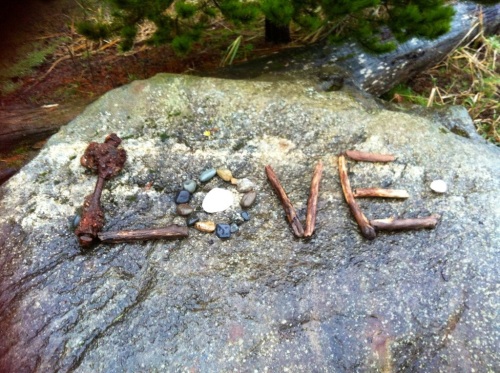
Here are your laurels. Lie down and take a nap on them.
This is good, it’s funny, and it’s freaking true. Dear God, please: not again.
Message to Ralph Nader
May 8, 2008 · No Comments
→ No CommentsCategories: culture
Tagged: Nader, Ralph Nader, third party
Not on my watch! A working meditation story about recycling.
April 16, 2008 · 3 Comments
The first week of April I participated in silent vipassana retreat at Spirit Rock Meditation Center in Marin county. It’s a beautiful sanctuary in the foothills east of Point Reyes National Seashore that’s been around for about 25 years.
Of course, there was sitting meditation and walking meditation, and for me the first couple of days, running meditation until I wore off some excess neurotic energy and could settle down. There was also Working Meditation which involved the upkeep of the center, tasks cleaning up after the 80+ retreatants, and of course the kitchen work–everything involved in feeding everyone, and all in silence.
I selected what was arguably the least attractive task of all, since there were no other volunteers but the task is slated to have two do it: recycling and composting. I did it because I was very interested to see what processes were in place to minimize the enviro impact of this large group of hopefully mindful meditators.
I inadvertently asked for more than I bargained for since the one thing they left off the title of the task was “Garbage.” That’s right, dining room garbage collection, recycling and composting. I was bummed the first day and certain that this level of real work would destroy any chance I had at peace of mind.
As it turned out, the garbage collection part became the most intriguing. The instructions I was given was to avoid using too many of the large plastic bags since, of course, plastic bags are forever. I took this instruction to heart immediately, vowing secretly to myself that no more than one large plastic bag would be used per day…for well over 80 retreatants and 30 staff. Three meals a day.
Could it be done? Indeed it could. I aggregated everything I could, without putting back messy bags for reuse. How? Well, the retreatants became very adept at and willing to scrape their plates clean into the composting buckets, and as the week wore on, they seemed to take no more than they would actually eat, making even less compost, and certainly very little garbage. Therefore, the only thing that went into the garbage were things like unrecyclable tea containers, plastic wrappers (not many of those), and other kitchen packaging that couldn’t be recycled. The recycling was very thorough, boxes broken down and picked up en masse, and one large container for most everything else.
The composting consisted of rotating buckets with lids that were picked up daily and taken to a cycle of seven large bins with contents in varying states of vermiculture. The end product is then worked into the gardens and grounds for a lush environment.
In other words, there wasn’t much garbage. Hard to imagine in our throw away society, right?
So, I was able to keep to my vow of no more than one large hefty-style bag of garbage per day for a retreat of over 100 people. I’m skimping a little here, because I know the kitchen had its own process that I didn’t participate in, but basically, the process was enviably efficient and effective. And quiet.
I learned to truly enjoy my work meditation.
→ 3 CommentsCategories: community · environment · local environment
Tagged: composting, plastic bag, recycling, silent retreat, spirit rock meditation center, vipassana, work meditation
plastic: the dawning realization
March 23, 2008 · No Comments
So, what I’ve figured out over the past two weeks: not using my car is like a walk in the park compared to managing plastic. You can clean and save all the bags and re-use them week after week at the grocery store until you are blue in the face and it will still barely make a ripple in the vast ocean of plastic that comes into the home simply in packaging.
And those are the recyclable kinds of plastic. Everything, it seems, is wrapped in some kind of plastic–most of it non-recyclable. So, we’re already a little bummed. The bag of plastic recycling under the sink is growing more slowly than it used to, but it’s far from empty. Where are we going to put all this plastic the entire world is now using to package everything–just packaging, mind you! This is just the stuff you take the desired item out of and toss–landfill, landfill!
Today, with little prodding from me, my partner remembered to use the recycled plastic bags I’d brought and we managed to get out of the store with No New Bags in tow. But hey, if you’ve set your sites on living a wee bit greener, ditching your car and riding your bike is a thousand times easier. Why? Because you have more choice in the matter.
Okay, a little bummed but undaunted, I continue in my quest.
And I wanted to share a little story. A friend of mine, when she heard about my new project to reduce plastic bags and such from my life, read the previous blog and told me of an amazing plastic bag feat: the trash can liner in her home office is the same plastic bag she’s used for 12 years. 12 Years! That is so awesome and such an indication of how plastic lives on and on and on and on….
So, the experiment continues… I think the next step is to begin learning about what other people are doing about Plastic. More soon.
→ No CommentsCategories: composting · culture · green · green lifestyle
Tagged: plastic, plastic bags, plastic packaging, recycling
Plastic: the beginning.
March 12, 2008 · 2 Comments
My grandmother had what seemed from to me, a funny habit with plastic bags. But first, let’s back up.
When I was a little kid, we had wax paper. We had wax paper for sandwiches and wax paper for covering bowls in the fridge, wax paper for all the uses where plastic is used now. Plastic obviously took the whole storage and freshness question to new heights, it was a boon, a valuable invention.
So back to my grandmother. When plastic bags started replacing wax paper, she saved and re-used the plastic bags–which were, as I mentioned, seen as valuable and not yet ubiquitous–for all kinds of things. She thought they were a miracle invention–precious almost.
As my grandmother aged, and I alongside her, I noticed a growing abundance of plastic bags in her house. In drawers, jammed in with the pots and pans, stored in grocery bags. She still felt they were precious and besides, they were still good–and she was from a generation that used things until they were worn out. Nowadays we only plan on using things until the marketing arm of various companies tell us to dump the old thing for the new thing.
My grandmother hadn’t made the change in her mind–she never made it, in fact. She never quite got over the value of plastic bags, never saw them as disposable, because they were still good. In fact, back in the 70’s, I recall various contraptions people designed to help re-use plastic bags. They were in vogue for about a new york minute since people largely can’t be bothered with so much effort to re-use the thing we can throw away and get so many more of in the same new york minute.
So when she became too old to be in her home and had to move to a care center, at the ripe old age of 94 (she lived to 101), we had to clean out her house to put it on the market. As you can probably guess, there were stashes of plastic bags everywhere–and I mean everywhere. She continued to re-use them but who can possibly re-use as many as are coming in? It was a phenomenal sight–bags of plastic bags in the cupboards, in the drawers, in the hall closet, everywhere.
And I think back now to this now with a larger frame in mind. I think of my grandmother’s unwitting demonstration of how many plastic bags one can collect, use, and dispose of one’s lifetime. She was a living experiment–she actually kept most of the plastic bags that came into her possession and it was an unbelievable sight. The amount of plastic bags we collect is, honestly, phenomenal and unthinkable.
Changing my own plastic bag habitz
I’ve started on my new habit changing project and we’re doing pretty well with it, as a household. Plastic bags we use and can re-use go right back in the canvas bags for use at the store in the coming week.
Plastic bags that are manufactured to hold things with zip lock tops–like raisins, nuts, what have you–are cleaned and used for sandwiches and fridge storage. Sure, they have branding all over them, but hey. You get used to it.
I’m already seeing a big reduction in the plastic recycling bag we keep under the sink. It used to be brimming most of the time with bags, but it’s pretty lame and empty right now–a good sign. So, how will I measure success? Haven’t figured it out yet, but so far, the switch to being conscious about plastic is going well.
Except for the depressing realization that plastic is everywhere all the time, and the gnawing question about where all that plastic goes…but I’ll leave that for another day.
→ 2 CommentsCategories: culture
Tagged: food storage, landfills, plastic bag, plastic bags, re-use plastic bags, recycling, wax paper
Days 360-365: MLwC hits the Year End Mark
February 25, 2008 · 2 Comments
So, I thought in honor of the project that has changed the way I think about driving–this grew-up-in-Southern-California-you’ll -take-my-car-from-my-cold-dead-hands girl–I thought I’d review some of the high points along the way.

First, recollection of the project’s goal as I’ve stated it on the blog:
MLwC stands for My Life w Car, a year long project to think differently about alternate transportation options and related issues…like, jeez, I never knew how angry driving made me until I stopped. Nowdays, I mix it up: bike, bus, ped, and yes, I still drive…though nowhere near as much as I used to. I may ditch my car at the end of the year–I like to think it’s possible. But I’m spending the year figuring that question out. For now, it’s enough that I’ve changed my habits in a big way.
For the big question, will I ditch my car? No, it became clear about midway that it made no sense to ditch a perfectly good, fully paid for car that works fine and is not sooo old that it’s a polluting disaster. Flexcar is good if you don’t have a car. But I’ve managed to completely change my transportation habits to include bike, bus, walking, ride sharing in my normal activities, and drastically reduce my car use period. Good enough.
And now for some of the high points along the year where I had some clear and habit changing insights. Here are the posts I would send the interested reader to:
Day 95: Walking! The subject of walking instead of driving brought up a lot of feelings for readers and myself. Walking takes longer, but the calm and enjoyment one gets from it really resonated with people. I started walking more and found I loved the parenthetical space it created–when you’re walking, you’re just walking. Looking around, hearing birds, being part of your town–and slowing things down a lot. Maybe some can’t imagine slowing things down and to them I just say: too bad, your loss. You should try it, you might like it.
Day 99: I really started to understand how things would change if I changed my habitual approach to transportation. Also, I found that discussing the project with others opened up a lot of questions and interest with my circle of friends. I didn’t expect the kind of interest the MLwC project engendered.
Day 116-118: In the process of removing habitual driving from my life, I became aware of the connection between driving and CONSUMING! You get in the car and you go…to get stuff. The two–the need for stuff and the trek to get the stuff–are so intertwined it takes a real effort to untangle them. This realization led me to discover the San Francisco Compact–a group that is dedicated to not buying anything for a year. Amazing.
Day 160: Continuing on the issue of consuming, I truly get it! Moving quickly, hopping in the car, is the quickest route to impulse buying possible. Making things easy is truly making things a lot worse in the whole big picture. Fast food, fast cars, fast this and fast that–I’m just not sure we’ve got the right goals in mind. I know this perspective makes me a bad capitalist, but hey.
Day 191-194: I’m starting to really understand how things have changed from the 50’s to now. Unbridled populations growth as a machine for consuming and using every resource that’s not nailed down. No wait, we’ll use the ones that are nailed down, too.
Days 213-214: Considerations about the older car, the urge to have something new, new, new! And plus, I just love the title of the post: The discreet charm of the older car.
Days 218-221: this is an important post, one of those posts where I really get an insight into my mind. Bill McKibbon hits the nail on the head when he points out that more has not made us happier, it’s just made us anxious for More. And that mirrors my experience with driving precisely. And my driving is inextricably linked to my consuming.
Day 233-237: The Puget Sound region rejects a proposal to build more roads! This is a watershed moment in more than one way!
Days 273-277: I took my car on a road trip, a rare experience. How rare? Well, I was completely unaware how expensive gas was, and I had a rude awakening that cars actually need oil now and then.
Days 241-243: One of my most favorite posts of all. This chronicles a trip I made to a day long meditation…and how crazy I made myself trying to get there on time in a traffic jam. I learned well the concept of “No Escape.” And I’ve thought of it often since this day. There a follow-up of this post here. This period was a real turning point in understanding the habit of driving, the real deep down problem of it.
Days 287-290: a plea to change your life and change the world. We can all make a difference. We must all make a difference.
Days 332-338: a video about the Story of Stuff. I just want to call this out because it’s excellent and Annie Leonard deserves traffic!
So this year comes to a close. I know not many folks will want to read all the stuff I’ve chronicled over the course of this year, but the upshot is: I’ve learned how to live differently. I’ve learned that I can learn to live differently.
And because of this, my next target has already been selected: plastic bags and plastic containers. I’ll begin this project soon and have a killer kick-off post planned. Of course, the new post series title? MLwP.
Daily Stats: (Mon, Tue, Wed, Thu, Fri)
Car: 63 miles
Bike:5.0
Ped: 5.5 miles
Bus:
→ 2 CommentsCategories: Bus · Environmental Cause · Hybrid-electric bus · alternate transportation · alternative energy · bike · bike envy · breaking up with my car · built-in obsolescence · cadillac desert · calm clear mind · car addiction · carbon based · community · connections · culture · ditch your car · energy grid · environment · environmental activism · global climate change · green · green lifestyle · local environment · mass production · mass retailer goes green · personal action · planned obsolescence · pollution · population growth
Tagged: bike, car
Hillary speaks for me.
February 21, 2008 · No Comments
I really like Obama. If he gets the nomination, I will work for him because what I’m passionate about is taking back our country.
But I remain steadfast in believing that Hillary is talking about things that matter to me. I really believe she is the stronger candidate.
But besides all that, here’s a vid site that is worth looking at. Inspiring kids and adults and students and workers and computer geeks–anybody who wants to is sharing their stuff: Hillary Speaks For Me.
→ No CommentsCategories: culture
Tagged: Hillary Clinton
Day 353-359: MLwC and Just Days Away From My One Year End Date!
February 19, 2008 · No Comments
I’ve been racing around so much lately that I haven’t been able to post much, but I’ve got a lot on my mind–lack of posts doesn’t equal lack of thoughts.
First, this project over in Poulsbo is still keeping me tied to my car in a way I thought I’d gotten away from. But I do understand that the use of my car to get to work doesn’t really mean I should change any of the other rules and parameters I set in place over the course of a year:
- Combine as many tasks into a trip as possible; keep task oriented trips to a minimum
- Use bike, bus or ped as much as possible to do tasks or meet people
- Plan time accordingly (that’s where I’m running into problems now)
- Keep car usage limited to must-use or special use whenever possible
- Enjoy a calmer state of mind by avoiding traffic and the need-for-speed automatic thinking that happens “behind the wheel.”
I felt last week a familiar sensation that I’ve associated with quitting any addictive habit. It goes like this: I’m driving more than I want to and because of that, I should just give up and drive all the time.
I know that sounds inane. I know. But tell the truth: have you not told yourself the same thing about habits you’re trying to change before? For example, say you’re trying to quit eating so many sweets. And so you set a rule–no more sweets. The next day you go to work and it’s someone’s birthday or it’s a holiday or something special, and there are sweets. You don’t want to be rude so you have some…
Ughh. And then later, you just go, oh hell, now that I’ve had a small piece of cake, I should just forget about trying to not eat sweets and Bam! you’re back in the habit.
But it doesn’t have to work like that. You can flex, you can begin again, you can stay on course for the longer haul. And that’s what I’m trying to do now. Not giving up on the usual things like tasks and such, and in that way, I create space around the issue of my current commute. Without space, I can’t think creatively.
Next week: a review of turning point moments in my year long project.
Daily Stats:
Car: 82 miles (about 10 tasks, thank goodness)
Bike: 5.5 miles
Ped: approx 3 miles
Bus: zero: I’m missing the bus!!
→ No CommentsCategories: alternate transportation · calm clear mind · car addiction · connections · freeways suck · pollution
Tagged: car addiction, car usage, driving addiction, year long project
Days 346-352: MLwC and some caucus thoughts
February 12, 2008 · No Comments
Here in Washington, the state with the most bizarre electoral processes imaginable (I’m convinced it’s because by February in Washington, at least in Western Washington, we’ve all got cabin fever and have lost it big time), we had our caucuses on Saturday. I loved it, I loved it last time around as well, although I wasn’t at all interested in the candidates. It was a total Anyone-But-Bush vote and literally, I don’t think anyone at the caucus back in 2004 gave a rat’s ass which Dem ran. We chose poorly as a result, and to this day I can’t even hear John Kerry speak without wanting to scream.
But I digress. This year the energy was phenomenal, and meeting up with neighbors and new friends was better than ever. I hope people make this an every-four-year event–I think we all had a good time. Of course, as is known now, the vote went heavily to Obama, and that’s cool. I just want our country back, I don’t really care which candidate does it–and I firmly believe both could do it.
Which brings me to an interesting question I’ve been mulling over. Is it possible to stay with one’s choice without “splitting?” By splitting, I’m referring to that emotional way we tend to find negative reasons to support our positive choices. That is, I am for Person X because Person Y is terrible. Is it possible for us, or even desirable, to put the period in the sentence after the first clause: I am for Person X.
Case in point: I am for Hillary. I am not for Hillary because I’m afraid Obama can’t win, or because I think he’s a worse candidate, or because of any of the other reasons one might come up with. I’m for Hillary because I think she’s super smart, she’s tough, she single handedly moved the conversation about national health care out into the public dialogue (and took numerous body blows in the process), she’s not afraid of difficult issues and she’s passionate about things I care about.
Now here’s the rub: because I say those things, does that mean Obama doesn’t share some of those qualities, or even all of them–who knows? No it doesn’t. It actually doesn’t mean anything about Obama. I’m only talking about Hillary.
I found myself in a peculiar position at the caucus because I really didn’t want to–in fact felt strongly about it–say anything against Obama. I just don’t want to. I think he’s got sterling qualities and he’s enormously talented and gifted. I can’t bring myself to say anything bad about him, yet the expectation was built into the process–try and convince the undecideds to vote for your candidate.
Listen: both of these candidates are superb. One of them will speak to you for specific reasons, and you will be drawn to follow that candidate. This isn’t 2004, for god’s sake, with John Kerry as our candidate. It’s not Dukakis! We have two excellent candidates. Two awesome candidates! Only one will win the nomination and then we’ll have one awesome candidate, and we’ll take back the white house and the country. Period.
Daily Stats: (Mon, Tue, Wed, Thu, Fri, Sat, Sun)
Car: 81 miles (so many storms this week, I fairly gave up trying to get anywhere with anything but a car)
Bike: 5 miles (finally on Saturday, I took a tentative ride to run errands)
Ped: 3 miles
Bus: 0
→ No CommentsCategories: culture
Days 339-345: MLwC, a Can-Do Attitude and Hope
February 3, 2008 · 4 Comments
We democrats are lucky this time around: we’ve got two awesome candidates and I’ll be happy when either one of them wins in November–as I’m certain one of them will. Whoever gets the nod in the run-up, I just hope they have the good sense to step back and let the Repugnicans tear each other apart–I’m also pretty sure that will happen. What goes around comes around.
I’m disappointed that Edwards dropped out. I had my enviro and anti-big-corpo-madness hopes pinned on him, but I wasn’t heart sick to see him leave the race…we have such an excellent choice with Hillary and Barack. Except for one thing…that environment issue. Oh, and the big-corpo-madness issue. I don’t think either of the candidates raises my pulse on those issues and for that, I’m truly hoping for a miracle once they get in office. I’m hoping for some enlightenment, as neither one has a strong track record or seems a strong champion for issues that are big for me. Still and all, as a country, we can only do better, and we have only to put the past eight years where they belong–behind us–and move on in a better direction.
I’m rooting for Hillary because I think she’s a woman with a can-do attitude. She’s an incredibly hard worker–and like so many women who have had to fight hard to get half the respect they deserve, she’s got some rough edges. I understand that, and I even appreciate that. I understand her demeanor, which at times can be brusk–it doesn’t sway my sense that she has the experience, knowledge and passion to lead us in a direction I wholeheartedly support. I would love Hillary to be a resoundingly successful first woman president of the United States.
But this morning I was thinking about something. I was thinking about how hopeful I was when Bill Clinton was first running for office back in ‘92. 15 freaking years ago–I can hardly believe it. Bill Clinton was incredibly hopeful and inspiring and he came from virtually nowhere to win the nomination, and he played music I could relate to, and he was simply the voice of the same section of my generation that wanted a progressive force in the white house after so many dismal years of Bush 1 and Reagan (no, I don’t think Reagan walked on water–I’m from California and witnessed his cold-hearted elitist governing style first hand).
Bill Clinton offered hope that things could be different, and I was swept along with it. All in all I think it was a good presidency, though there are some things I still wish he’d done differently (that’s an understatement). Clinton, both Hillary and Bill, wear the scars of that time.
If Barack gets the nomination, I know he’ll win the presidency, and I’ll help. He’s not my first choice, not even my second choice–but I get the draw. I get the pull of hope, the resonance of a generation chomping at the bit to do things differently, and I hope he’s able to change things, if that’s how the nomination shakes out. More than anything, I’m looking forward to a healing, forward looking president. I remember the allure of hope–it can move mountains.
Daily Stats: Mon, Tue, Wed, Thu, Fri, Sat, Sun
Car: 88 miles (a lot of biz and 14 tasks)
Bike: 0
Ped: 5
Bus: 0
→ 4 CommentsCategories: Environmental Cause · blessed unrest · corporate culture · culture · environment · politics
Tagged: Barack Obama, Can-do attitude, change, democrat, Hillary Clinton, Hope, primary, progressive, vote
Days 332-338: MLwC and The Story of Stuff
January 27, 2008 · No Comments
When I started this year long project to examine and change my transportation habits, I had a sneaking suspicion that no matter what I did–ride a bike, take a bus, walk, drive my car–one fundamental thing had to change: driving less means using less. Driving is about Consuming, pure and simple, and what I’ve learned is that as I’ve driven less, I’ve consumed less in all kinds of ways. And using less is good. It’s anathema to our culture, but it’s good…and I keep coming back to it, again and again.
Writer, researcher and activist Annie Leonard has been spending the last 10 years thinking about and researching our material-based culture. She’s been talking about it too, but has not been able to gain traction…until she put together a truly brilliant 20 minute film that’s easy on the eyes and brain, but still packs a punch. She also changed the name of her focus from material usage to Stuff.
Watch The Story of Stuff–watch it now! it’s so right on, and encouraging too–we can change the way our obsolescent-dependent culture drives us crazy!
Take some time to watch her film, The Story of Stuff. What it’s about: like the title suggests, it’s the story of stuff. And she manages to take a systems approach to our whole way of life, our entire culture to explain just how stuff works…and how we participate in the creation, consumption, and disposal of stuff. It’s an untenable cycle of life, pure and simple.
And the only way out is: use less, consume less, need less. Do less, buy less, create less. Whatever happened to Less is More? We’ve completely lost touch with the concept–and now we are mindlessly buying, using, consuming, trashing more stuff than ever in the history of the world.
I suspect that once my year of transportation evaluation is over I may be turning my personal attention to this issue. And it is incredibly thorny–everything in me wants what it wants and wants it now. I’m as culpable as the next person, sometimes more, in terms of consuming–but I know, I KNOW, this cannot continue and the only thing I can do is change my own habits. I know I can systematically look at how I buy and consume and begin to deconstruct it, bit by bit–and begin to Stop Doing What I’m Doing.
And I also suspect that I will be zeroing in on one area of massive consumption that nearly epitomizes all that’s wrong with corporate supply-and-demand: processed food.
Now that I’ve said that, do watch this film and consider the role of Corporations in her explanation. And again, I point to John Edwards as the only candidate in the field who has strongly addressed dual issues regarding Corporations, the environment, and the cycle of greed that drives the growth of corporations.
Not endorsing, I’m just sayin’….
On my transportation front: I’ve been so busy lately, I haven’t been able to post on a regular basis. On the other hand, I’m starting to think about weekly transportation caps–I haven’t gotten my route to Poulsbo figured out yet, ie, bus use. I’ve got too much to juggle right now and things haven’t calmed down. So I’m still successfully keeping my car usage down, but have also targeted a 75 mile a week cap. I’m well under that this week with 51 miles, so that’s all good. Is 75 miles a week too much? Does that seem reasonable? Any thoughts out there?
Daily Stats: (Sun, Mon, Tue, Wed, Thu, Fri, Sat, Sun)
Car: 51 miles
Bike: 7.0
Ped: 5
Bus: 2 miles
→ No CommentsCategories: alternative energy · blessed unrest · built-in obsolescence · community · compact · consumerism · culture · environment · environmental activism · mass production · personal action · planned obsolescence · population growth
Tagged: Annie Leonard, built-in obsolescence, consumer madness, less is more, The Story of Stuff
Days 323-331: MLwC, the easy Shake ‘n Pour Pancake mix & John Edwards
January 19, 2008 · 2 Comments
In the annals of things I would not have thought needed improvement: pancake mix containers. There’s someone somewhere who’s job it is to figure out how to improve on things that work fine in order to sell more products, and I think that might not be a very good use of someone’s time–I don’t care how much they earn.
Take Bisquick’s Shake ‘n Pour bottle of pancake mix. Is it really so very very difficult to make pancakes from the mix in a box? Do we have to make a plastic bottle to hold a chemically processed liquid so all you have to do (we’re very very busy!) is shake it and pour it out? I happened to see this product on TV the other day and really was taken aback.
Plastic bottle: will not decompose in that very busy Mom’s lifetime, nor the span of her kid’s, or even their kids.
Pancake mix: processing and shelf life virtually guarantee there is zero health benefit to the “food”–it’s just filling bellies, and likely has so much sugar and salt that the kids would be better off with a slice of toast and peanut butter. Much better off.
I know, I know–why should I care? But I’ll tell you why: I just spent a few days with my nephew who is 34 and fights with diet/nutrition issues. He’s grown up in a mass-consume culture, more accustomed to the taste of processed sugar than real food, and now when he’d like to change things, it’s extremely difficult. And as he gets older, his health problems will increase, his dependence on medications will increase, his positive participation in our culture will decrease–and that breaks my heart.
This is our culture, people. This is our country, our culture. I literally don’t think having a plastic bottle of pancake mix is making us any better–it’s just growing profits for General Mills.
Which brings me to John Edwards. I read the other day, though I can’t find it now, that some columnist was backing John Edwards, against all odds, because he felt that one of the core problems in our country, if not the world is the rise of unchecked corporations and of all the candidates out there, the one candidate that truly understands corporations and how to battle them effectively is John Edwards. It strikes me that that reason alone may be contributing heavily to his virtual invisibility in the run-up to the race.
But beyond his profession, Edwards’ tone and language on the campaign trail have increased business antipathy toward him. His stump speeches are peppered with attacks on “corporate greed” and warnings of “the destruction of the middle class.”
He accuses lobbyists of “corrupting the government” and says Americans lack universal health care because of “drug companies, insurance companies and their lobbyists.”
Despite not winning the two state nominating contests completed so far, with 48 to go, Edwards insists he is in the race to stay. An Edwards campaign spokesman said on Thursday that inside-the-Beltway operatives who fight to defend the powerful and the privileged should be afraid. (credit: indybay.org)
I’m not suggesting I’m backing Edwards–in fact, I don’t know yet who I’m backing. Any of the top three would be good, to be honest. But the issue with corporations is exceptionally important. We are currently suffering the burden of the polar opposite of Edwards: an administration so thoroughly in lock-step with corporations, the relationship is nearly seamless.
Apologies to Edwards for discussing General Mills’ ridiculous products in the same post as the presidential nominee, but in terms of corporate hunger for products above brains, it seemed to connect up for me.
Daily Stats (things seem to be getting way out of hand in terms of tracking progress in these final weeks of the year long MLwC project: Sat, Sun, Mon, Tue, Wed, Thu, Fri, Sat)
Car: 64 miles (P-bo, a dozen tasks and 8 days)
Bike: approx. 15 miles or so, several tasks
Ped: 5 miles
Bus: 0
→ 2 CommentsCategories: composting · consumerism · corporate culture · design · mass production
Tagged: Corporate responsibility, John Edwards, stupid plastic containers
Days 318-323: MLwC and how to plan for bike traffic
January 11, 2008 · No Comments
In a recent NYTimes article, we find a discussion of bike safety in bike-haven Portland, Oregon. Portland is probably America’s most bike friendly city, so if bikers get killed by cars there, you gotta wonder why.
Turns out that most bike accidents happen at intersections. My own bike-car face-off (I lost) of some years back happened at an intersection. It seems that drivers are only really paying attention to a couple of things at an intersection, those being: 1)when will this freaking light change so I can step on it, and 2) I don’t have to stop because I’m turning. This second issue is the one that nails a lot of cyclists, quietly parked off to the side waiting for the green light. Not enough bulk, not enough chrome, not enough of something that can be easily seen by car drivers.
By allowing cyclists to wait in front of motorized traffic, the bike boxes are intended chiefly to reduce the risk of “right hook” collisions, the kind most frequently reported in Portland, in which a driver makes a right turn without seeing a cyclist who is in his path. Drivers will not be allowed to pass through the bike box to turn right on a red light, although many right hooks now occur after the light has turned green, when traffic quickly accelerates.
Right hooks were what killed the two cyclists in October, a college student and a bike racer hit by large trucks. The drivers say they did not see them.
“In a lot of people’s minds they weren’t doing anything wrong and they were just run over,” said Roger Geller, bicycle coordinator for the Portland Office of Transportation.
It will be interesting to see how this works out with Seattle’s neighbor to the South. Seattle is in the process of creating a bicycle task force to help guide development of bike transportation–which currently needs a LOT of guidance.
Daily Stats: (Sun, Mon, Tue, Wed, Thu, Fri)
Car: 37 miles (trip to Poulsbo and back for work)
Bike: 9.5 miles (4 tasks)
Ped: 4 or 5 miles
Bus: 0
→ No CommentsCategories: alternate transportation · community · culture · ditch your car · sustainable transportation
Tagged: bike boxes in portland, bike car collisions, bike fatalities, seattle bike
Days 314-317: MLwC and How I Became Stupid
January 5, 2008 · No Comments
Great title, eh? How I Became Stupid is a wee novel I came across recently by French author Martin Page. His first novel, it’s billed as a “humorous & surprising mixture of optimism and nihilism.” Oh those French! It’s a quick, entertaining and thought provoking read which brought up a lot of the same questions and issues that have come up in my year long MLwC project.
Basically the protagonist, at 28 years of age, becomes tired of his life of introspection, self-awareness, and intelligence in an increasingly fast-paced consumerist society that values quick money and fast cars over all else. He tries three ways to become stupid, finally landing on a solution: take the anti-depressant HappyZac and become a stock broker. The HappyZac changes his life completely; he no longer feels compelled to think through anything. He even finds himself one day achieving benchmark status as a non-thinking person by ordering a Big Mac at a McDonald’s…and liking it. The world takes on a rosy glow.
In his new life as a stock broker, much like the monkeys in the famed stock picking experiments, he picks winning stocks through whimsy and error, resulting in million dollar wins, gi-normous bonuses, moves to a glitzy ultra-modern apartment, gets the fancy he car he doesn’t drive, dumps his quirky, creative and loving friends, and basically adopts a stupid life. I won’t spoil the end
Here’s a quote from his Before state:
Before, he hadn’t been able to live his life because of all the questions and principles tangled in his mind. For example, when he bought clothes he would always check where they came from so that he wouldn’t be participating in the exploitation of children in Asian sweatshops owned by multinational corporations. As advertising is an assault on freedom, a coup d’etat every company that investing in morally questionable activities, pollutants, or nondemocratic countries, or who laid off people when their profits were increasing. He didn’t eat food full of chemicals, either, or anything containing preservatives, coloring, or antioxidants and–financial circumstances permitting–he bought organic.
It wasn’t so much that he was an ecologist, a pacifist, or even and internationalist–just that he did what his conscious told him was right; his behavior derived more from moral principles than from political convictions. In that, Antoine was not unlike a martyr of this consumer society, and he was perfectly well aware that his intransigent attitude begged comparison with Christian mortification. This was an embarrassment to him because he was an atheist, but he couldn’t act any other way, he couldn’t help being this sort of renegade, secular Christ….
Now, basking in the chemical sunlight of Happyzac, Antoine discovered the World….Since he’d been taking his little red pills, salvation had come in the form of an absolutely watertight dam between the wold and its long-term consequences.
On his McDonald’s experience:
Only a few days earlier Antoine wouldn’t have been able to make that simple gesture of eating a French fry without thinking about the bloodstained history of the potato, the human sacrifices that the Aztec civilization made in it name, and the appalling suffering it visited on the Irish….He took a rather awkward mouthful of his burger…he had to admit he liked it. It was clearly not very good for your health, the packaging probably wasn’t biodegradable, but it was simple, cheap, very caloric, and it had a satisfyingly reassuring taste. In fact the taste of it made him feel as if he had found a family that knew no frontier, as if he had joined millions of people biting into an identical burger at that precise moment….He had a subtle feeling of pleasure, of confidence, a new strength derived from the fact that he was as others, with others.
As a novella with an “International Cult Following,” How I Became Stupid is a quick, fun read for those of us who do not always follow the road laid out for us by the Market, nor even use a car when we’re off the beaten track.
Daily Stats (Wed, Thu, Fri, Sat)
Car: 34 miles (Bellevue and back)
Bike: 5
Ped: approx 4
Bus: 0
→ No CommentsCategories: built-in obsolescence · community · consumerism · culture · environment · green lifestyle · personal action · satire
Tagged: How I Became Stupid by Martin Page
Days 308-313: MLwC and random New Year Thoughts
January 1, 2008 · No Comments
It’s going to be a very good year. I got a new squirrel feeder for Christmas from my nephew’s kids who are smitten with our resident squirrels, all of whom are named (of course) Sandy. The new feeder is the one they use in some state parks, and is pretty cool, looks like this:
Ours is rougher than this, but the same idea. So far, the stellar jays have made it their own because Sandy is accustomed to coming to the door for direct hand-outs, but they’ll find it soon enough.
A friend of mine in Sandpoint, ID, where we spent some lovely days this week snowshoeing, eating well and playing, was wondering what kind of bird feeder she could get that would keep squirrels and other varmints out, and after years of experimentation, I suggested the one we’ve currently got which is the only one that not only feeds our target audience of finches, chickadees, juncos, and others, but keeps the local ring tail doves from chowing down every last shred of food, and the jays and the flickers and others. They get the scattered seed on the ground as well as other treats, but will clean out your store of small bird feed quick as you can say Yipes. This feeder is called a Squirrel Buster and you can
It looks like this:
So why should anyone care about this, other than because having song birds around is a pleasant thing? Especially in urban settings, habitat loss is a real threat and food sources become key–not just to resident bird populations but to migratory birds as well. Most of us don’t consider that our homes may be part of a larger migratory pattern and some species may actually come to rely on food we supply to get where they’re going. I know the Wilson’s Warblers and Varied Thrushes come through our yard at specific times every year, on their way somewhere…who knows where, but they show up like clock work. At our house, we’ve participated in a number of backyard and neighborhood bird counts that help larger organizations like Cornell Ornithology Labs and Nature Conservancy track movements of populations through urban areas.
“The greatest threat to songbird populations is habitat loss and fragmentation in their wintering and breeding grounds, and along their migratory routes. Birds must find rest areas with an adequate food and water supply to enable them to continue their journey. Conservationists are placing greater importance on these stopover points hoping to reverse the trend of songbird decline. “
So, making a sweet spot in your own backyard could have untold positive benefits for bird populations that you might not even realize! It all counts, and anyway, the heralding sound of song birds in late February is a treat not to be missed.
Happy New Year Everyone!
Daily Stats: (Thu, Fri, Sat, Sun, Mon, Tue)
Car: 8.5 (three tasks)
Bike: 0
Ped: approx 10 miles
Bus: 0
→ No CommentsCategories: West Seattle · community · connections · culture · environment · global immune system · green · personal action · wildlife
Tagged: Bird feeders, migratory birds, Sandpoint ID, Sandy the Squirrel, squirrel feeders, urban birds
Days 301-307: MLwC and an idea about consumption
December 26, 2007 · 2 Comments
That’s consumption in the modern sense of the disease: think SUVs crammed with stuff. Come on, most of us did it to one degree or another this season, even if we didn’t use an SUV to haul the stuff around. So, let’s try to take our consuming habits apart one piece at a time. For example, did you buy a lot of stuff that will inevitably end up in land-fill, not only because the target user outgrew it, out-used it, or never really wanted it in the first place?
So how to think about that….I didn’t really do so much less this year, but what was different was this: I focused on making sure what I did buy or make was recyclable or immediately consumable (food, eg). I made calendars for all my near and dear ones…perhaps to their chagrin, who knows. But at the end of the year, they can toss those puppies in the recycling bin and the paper will be mashed up and turned into something else. We offered a feast of special delectables to our friends–pricey, fancy, certainly impressive. Everyone thoroughly enjoyed themselves and we had a blast. We gave beeswax candles which burn clean. We bought and downloaded music–no muss, no fuss. We gave gifts to kids that are recyclable or immediately usable or edible. We also endeavored to simply buy and give less, but make it mean more.
Wall Street is bemoaning the fact that even though spending on the holidays was robust, it was less than they hoped for and so they’re calling the season a disaster. Go figure. I ran across a blog this morning that helped me think about the prayed for endless upward trend on spending–something virtually unheard of in the natural world:
….I didn’t consume this season because of that as much as for the sake of the earth and equality and a chance for my kid to come of age in a world where a person’s worth is not measured by the limit on their plastic or the cubic footage of their SUV.
As any medical professional will tell you, untrammeled growth at the cellular level is known as cancer. But lots of economists and financial reporters don’t see the point in that: they say we need uncontrolled, rabid, nuclear growth at all times and especially at Christmas. I mean, look at all the good it’s done us, how sweet and warm and fuzzy is the cult of metastatic consumption, what blessings it has poured upon our nation and our planet.
I have had this same conversation with a lot of people before, usually those somewhere right of me who believe–literally believe—that endless growth and consumption is not only good, but what the Lord had in mind. I think they do a disservice to the Lord. Nothing, absolutely nothing in nature–outside of cancer–grows endlessly without dire results. It’s simply not possible, divine intervention or not. So, maybe it’s a good thing to see us slow down a little on the holidays. I know we focused more on sharing ourselves and making room for more good times together…and the results have been a real holiday, one full of friends and family and quiet and raucous times together.
Another note, on the MLwC project. I mentioned previously that on Thanksgiving, we took my car for a trip up to the San Juan Islands–a fabulous Thanksgiving of bike rides and hikes with sweeping views of the Straights. I had some car trouble, it was diagnosed as okay, but needing attention back in town. I got the attention and got the car fixed last week–for free. It seems the very expensive part that had worn out (catalytic converter) is covered on my car as long as I’ve put less than 90K miles on it. Not only was I less than 90K, I was less than 50K! So, another reward of less driving: you actually get a chance to use that methodically planned warranty they attach to the car when you buy it. Now my car is running smooth and happy, when I use it. Which it seems is quite a lot over this rainy, cold holiday season…..
Daily stats:
Car: 324 miles (out to the coast to visit family and back, plus several errands)
Bike: 0
Ped: approx 8
Bus: 40 miles
→ 2 CommentsCategories: built-in obsolescence · community · consumerism · culture · environment · friends · global climate change · personal action
Tagged: buy le, buying less this christmas